The group is interested in developing sustainable organic processes by means of photochemistry; examples include the activation of small molecules such as carbon dioxide, or the transformation of abundant feedstocks for their conversion into high added value products. We pursue a design of the photocatalytic processes based on a mechanistic comprehension of the organic photochemical reactivity. Specific research topics include:
1) Carbon dioxide capture, reduction and fixation. We have reductively fixed CO2 into extended conjugated organic scaffolds, and provided an example of vinynilogous carboxylation of dienones (https://doi.org/10.1021/acselectrochem.5c00078). We are also interested in understanding the fundamental reactivity of CO2, by defining its electrophilicity and the energetics of its reactivity with carbanions (https://doi.org/10.1039/D4SE01065E). We fixed CO2 by photochemical routes with organic photocatalysts, and exploiting PCET mechanisms (https://doi.org/10.1021/acs.joc.2c02952).
2) Photooxidations of industrial interest. Read our minireview in Angew. Chem. Novit. (https://doi.org/10.1002/anov.70007), and check our photocatalytic approach for oxidative valorization of glycerol (https://doi.org/10.1002/adsu.202400538)
3) Rational development of novel organic photocatalysts. See how we combined industrial pigments with TiO2 nanoparticles to promote valorization of glycerol with red light! (https://doi.org/10.1039/D5TA01970B) This work, comprising organic synthesis, material preparation, and photocatalysis, was adapted for laboratories for the master degree in materials science at UniPD.
4) Development of super-redox reactivity by combination of photochemistry and electrochemistry. Stay tuned for a publication soon!
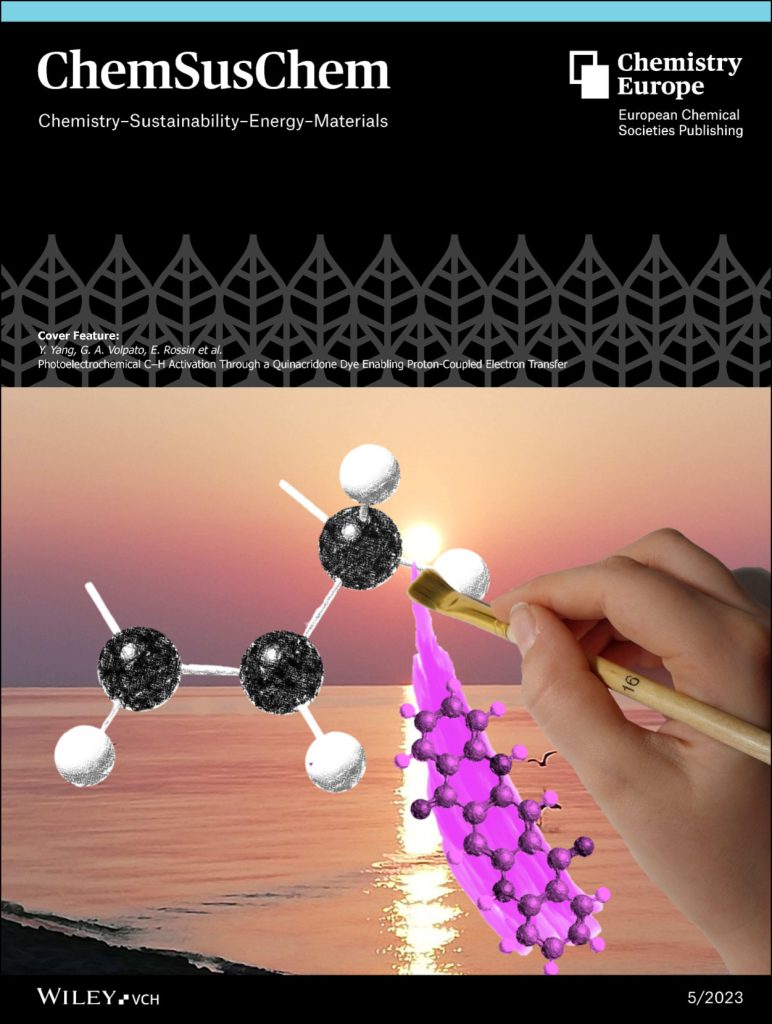
5) Hydrogen atom transfer and proton-coupled electron transfer. Dyes that operate through PCET can promote C-H activation (https://doi.org/10.1002/cssc.202201980). Multiple PCET in oxygenic photosynthetic cycles (https://doi.org/10.1039/D4SE00146J).